Tree Removal - Ground Up Tree Care LLC
Tree Removal Services
Tree removal is a critical service when trees are dead, diseased beyond help, or pose immediate hazards to people and property. At Ground Up Tree Care LLC, we understand that tree removal is often a difficult decision for property owners due to emotional, aesthetic, and environmental considerations. Our approach is to provide clear evaluations, safe execution, and respectful site restoration. Whether you need a straightforward removal in an open yard or a complex dismantling near structures and power lines, our trained crews deliver professional service with a focus on safety and minimal disturbance.
Why Professional Tree Removal Matters
Improper tree removal can cause severe property damage, personal injury, and legal liability. DIY removals or inexperienced contractors may underestimate rigging needs, fail to account for hidden hazards such as rot or weight distribution, and cause collateral damage to landscaping or structures. Professional removal ensures:
Proper hazard assessment and mitigation.
Correct use of rigging and machinery to control fall direction.
Safe execution near structures, utilities, and public spaces.
Correct debris management and site cleanup.
Compliance with local permit and ordinance requirements.
When is Tree Removal Necessary?
Dead or dying trees
When trees have significant decay or have lost their structural integrity.
Disease or pest infestation
Severe disease or pest problems that cannot be realistically contained or treated.
Structural failure
Cracks, large cavities, or splits that compromise tree stability.
Safety hazards
Trees or limbs that pose immediate risk to people, vehicles, or property.
Construction and site development
Trees located in areas slated for development may require removal.
Clearance for utilities
Trees interfering with power lines or other essential infrastructure.
Our Evaluation Process
Our arborists tailor pruning strategies to local species, recognizing that timing and technique vary:
Site visit
An arborist inspects the tree(s), determining species, decay, root condition, and surrounding hazards.
Risk assessment
We evaluate failure likelihood and potential targets (structures, vehicles, utilities).
Recommended action
We present options: preservation, selective limb removal, reduction, or full removal with pros/cons and cost estimates.
Permitting
If local permits are required, we assist or manage the application process.
Safety plan
For complex jobs, we develop a detailed rigging and equipment plan and establish zones for bystanders.
Types of Removal Techniques
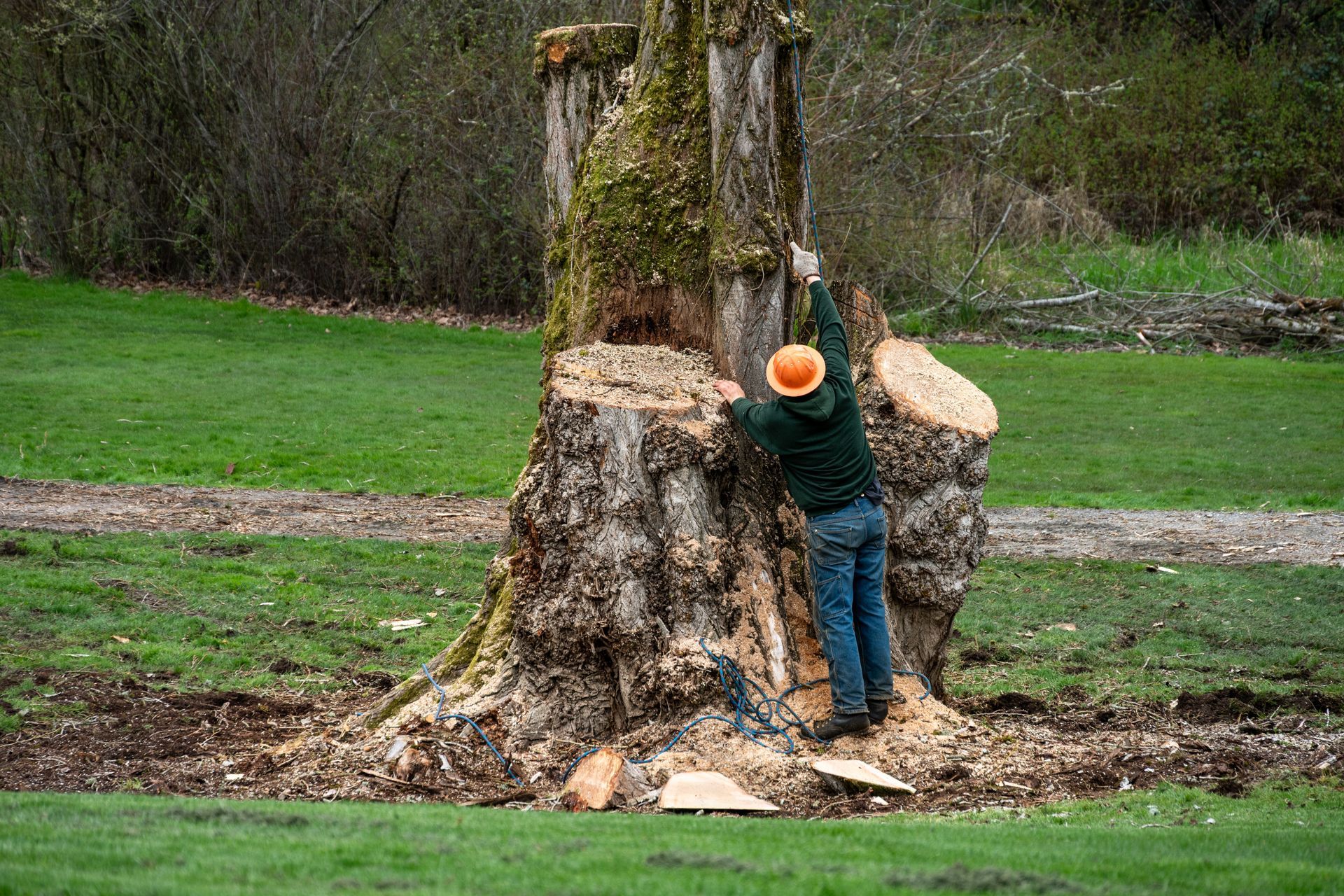
Sectional dismantling: Removing a tree piece by piece when space is limited or near structures. This is a common technique for urban or restricted sites.
Crane-assisted removal: For very large or hazardous trees, we bring in crane support to safely lower large sections.
Felling: Used when site conditions allow a controlled directional fell.
Mechanical removal: For trees in open spaces, mechanical cutting and loader removal may be used to speed the process.
Equipment and Capabilities
Ground Up Tree Care uses modern equipment including:
Climbing gear and aerial lifts/bucket trucks for access.
Stump grinders to remove stumps post-removal.
Cranes and rigging gear for complex or large-scale removals.
Trucks and loaders for efficient material transport.
Managing Risk Around Utilities and Structures
Trees near power lines require special coordination. We follow regulations and work with utility companies when necessary to ensure safe clearances. When working adjacent to structures, we use careful rigging to lower cuts and prevent damage. We also plan staging areas and access routes to minimize disturbance to lawns and driveways.
Disposal and Recycling Options
We provide flexible disposal options:
Hauling and disposal to local facilities.
Stacking logs for homeowner use or by-products for the community.
Recycling into firewood or lumber where feasible.
Costs and What Influences Pricing
Tree removal costs vary by tree size, complexity, location, proximity to structures or power lines, required equipment, and disposal needs. We provide transparent, itemized estimates and explain cost drivers so property owners can make informed choices.
Environmental and Aesthetic Considerations
Although removal eliminates a tree, sometimes it’s the safest or most responsible option. We discuss replanting strategies to replace tree canopy over time, recommend species suited to the site, and advise on steps to restore soil and plant new trees.
Emergency Tree Removal and Storm Response
Ground Up Tree Care provides emergency response for fallen trees and hazardous conditions after storms. Our crews triage by severity and prioritize public safety concerns, fallen trees blocking access, and immediate risks to structures. Emergency services focus on stabilizing the situation and performing safe, prompt removals.
Frequently Asked Questions (Detailed)
Do you require permits for tree removal?
Generally we don't require permit for tree removal.
How do you protect my property during removal?
We plan access routes, use mats or protective boards where appropriate, and limit heavy equipment to designated areas to prevent unnecessary damage. Our crew also restores the area as much as possible after completion.
How soon can removal be scheduled?
Scheduling depends on workload and season. For emergencies we prioritize hazardous removals. For planned work we typically schedule within a window that fits both parties; contact (715) 570-6162 for current availability.
Can you save wood for firewood or lumber?
Yes. We can cut logs to homeowner preference and leave them stacked for pickup or later use if requested. Fees may apply based on labor and hauling.
Contact and Call to Action
If you have a hazardous tree or need a removal estimate, call Ground Up Tree Care at (715) 570-6162. Our staff will schedule an on-site evaluation and provide a written plan for safe removal and site restoration.